F# as a Deployment Engine: From Material for MkDocs to Zensical
There’s a question that comes up more often than I’d expect when people see the sHEL repos for the first time: why F#? Not “why did you pick this language” — it’s more like, “wait, your deployment engine, your build system, your GitHub Actions workflows… are written in F#? On purpose? What are you smoking?”
Fair question. This post is the answer, and it’s the story of a two-repo arc: fsharp-material, born on May 25, 2026 as “F# Material for MkDocs,” and its rebranded successor fsharp-zensical, created on June 8, 2026 — the engine that this very site, docs.shel.sh, app.shel.sh, and everything else in the sHEL universe is built on. (Where it went from there — an orchestrator called orc that builds this blog — is the subject of another post; this one is about the machine underneath.)
The starting point: Material for MkDocs, May 25, 2026
Before there was Zensical, there was fsharp-material. It started on the 25th of May as a straightforward idea: take Material for MkDocs — which, honestly, is one of the best documentation theme ecosystems out there — and drive it entirely from F# source files. Every config, every page, every workflow: F#. No YAML by hand. No TOML by hand. No “I’ll just tweak this config file quickly” that turns into a half-migrated mess.
The commit graph from that day is fun to look at: fifty-four commits total in the repo’s life, and the first day alone was twenty-some, most of them README churn. The README was being written as a living document — “Add ASCII art section,” “Update README to use HTML for ASCII art,” “Refactor README to remove ASCII art and add F# code,” “Fix formatting of mathematical notation.” One day, one document, iterated until it was right. That’s the sHEL methodology in miniature: the docs are the product, and the product gets redesigned in public until it holds up.
By end of day one the shape was fixed:
- A
.github/config/tree of F# sources —deploy-docs.fs,deploy-website.fs,deploy-app.fs,deploy-blog.fs,dependabot.fs,pr-check.fs— that generate the workflow YAML at build time. - A
Components.fsAPI surface for the reusable page pieces. - A
sharpendabotstate machine (more on this below) that keeps dependency updates deterministic instead of flappy. - The core conversion story: F# source → Markdown → HTML via MkDocs, with F# doing the Markdown generation so that any page can compute, branch, and interpolate.
The key architectural decision from day one: every piece of site content is an
F# module whose body is a string. For example, an indexmd.fs file:
module ConvertedFiles.IndexMd

let file = """---
title: My Page
---

# My Page

{card}

!!! tip "Zensical Features"
    Admonitions, tabs, Mermaid diagrams all work!
"""

let render() = file
That string is the page. The build unwraps every such module — the “Zensical unwrap step” — writes the resulting Markdown/TOML/YAML out as generated files, and then hands off to the normal build pipeline (MkDocs for docs, Jekyll for the blog, static hosting for the app). The F# is the source of truth; the generated files are disposable.
Rebrand to Zensical, June 8, 2026
Nine days later, on June 8, the project got its real name: fsharp-zensical,
“F# Zensical for Github Pages.” The zensical repo’s commit graph is short
(19 commits) and tells the story: initial commit at 20:43, then
.github-repo-config.fs.example (the multi-domain mapping config), the YML
uploads, .nojekyll and .gitignore — the whole “make this a deployable
template” sequence — and README updates through the end of June.
The rename wasn’t cosmetic. “Material for MkDocs” described the first deployment target. “Zensical” describes the engine, which is what the project actually was: a fully-fledged F# deployment engine where Material MkDocs was the first template the way the Zensical engine is the first template for the engine. The README says it plainly: “Deployments to any repository are made with F# as a wrapper. The included template is for Zensical static sites.”
And because the two repos share a purpose, their READMEs are mirror images — the same ~981-line document in both, documenting the same engine. One repo, two hats: the Material flavor and the Zensical flavor.
The “why F#” question, answered properly
The README has a section on this, but the real answer is in the documentation — a “why F#” page under documentation/ — and it rests on one language feature: F# triple-quoted verbatim strings.
Here are the rules that matter:
-
No escape processing at all. A
"""-delimited string does not interpret backslashes, quotes, percent signs, angle brackets — nothing.C:\Users\teststaysC:\Users\test.\nstays the two characters backslash-n.%2Fstays%2F. This is why embedding JavaScript, CSS, or SVG in F# source is boring — there is no escape hell, because there is no escaping. -
F# 9 quote-juggling. You can explicitly jump in and out of string mode inside a triple-quoted string. A lone
"inside is just a quote. And a backslash before a quote ("”) is the one-off escape when you need to keep a quote pair from colliding with the delimiter. So the string that looks like it can’t exist — text containing both lone quotes and triple-quote-looking sequences — is expressible. This is exactly the feature that makes “content as data” sane in F# when other languages would reach for a templating engine. -
The engine’s own wrapper strategy. When a file does contain literal triple-quote sequences (like the F# code samples in this very post, or any docs page that shows F# source showing F# source), the wrapper can’t be a single verbatim string. The engine handles it by splitting the content at the offending sequences and joining the pieces:
module ConvertedFiles.Posts.N20250510FsharpZensicalMd

let file = System.String.Join("\"\"\"", [|
    """# F# as a Deployment Engine
    ...up to the first embedded triple quote...
    """
    """<the chunk that contained triple quotes, now a lone quote pair>"""
    """...the rest of the doc..."""
    |])

let render() = file
This isn’t a hack layered on top — it’s the programmatic route, produced by the
wrap-filecommand in the generator:dotnet run --project src/generator -- wrap-file page.md page.fs dotnet run --project src/generator -- wrap-batch pages/ out/So the workflow for any tricky document is: write the
.mdthe way you would normally write it, point the wrapper at it, and get back a guaranteed-parseable.fs. The wrapper handles F# fine — including F# source that contains its own wrappers. -
Everything downstream is type-checked. The unwrapped content is a string value with a
render()entry point, the module name encodes the destination path, and the whole tree is one F# program that compiles. A typo in a page is a compile error with file and line, not a 404 you discover from a search-engine click three weeks later.
That last point is the one that keeps me coming back. In YAML, a missing
colon is a mystery. In F#, it’s error FS0010: Unexpected token and a
pointer to the exact spot.
One engine, four subdomains
The other reason F#-source configs pay off: multi-subdomain GitHub Pages.
GitHub Pages’ hard rule is one site per repository. The sHEL universe needs four:
| Folder | Deploys To | Domain |
|---|---|---|
main/ |
website branch |
shel.sh |
docs/ |
docs branch |
docs.shel.sh |
app/ |
applications branch |
app.shel.sh |
blog/ |
blog branch |
blog.shel.sh |
The Zensical engine overcomes the one-site limit by building locally in CI
and pushing the built output to entirely separate repositories using
GitHub token authentication — the repo mapping lives in
.github-repo-config.fs (an F# module with an owner binding that
auto-detects from GITHUB_REPOSITORY_OWNER and a Cname table for the
custom domains). Each subdomain folder carries its own generated
zensical.toml, pyproject.toml, .nojekyll, and .gitignore. During
initialization, Actions pull the latest Zensical, .NET 10 LTS, uv,
Giraffe ViewEngine, and AngleSharp — the whole toolchain pinned and
reproducible, no “works on my machine” in the deployment path.
html2giraffe: drop HTML in /throw/, get F# back
The other half of the engine is html2giraffe: a converter that turns HTML into proper Giraffe.ViewEngine DSL. The intended workflow is deliberately low-ceremony:
# Drop any HTML file into /throw/
cp my-page.html throw/
git add . && git push
# The workflow parses it element-by-element,
# generates pages/my-page/index.fs with proper Giraffe DSL,
# and renders it to HTML for deployment
Input a one-liner like <h1>Hello World</h1> comes back as:
module Views
open Giraffe.ViewEngine

let page =
    div [ _class "container" ] [
        h1 [] [ str "Hello World" ]
    ]
Type-safe, composable, diffable HTML. For the parts that aren’t markup —
<script> and <style> blocks — the converter emits them inside
triple-quoted rawText strings, so embedded JavaScript with regexes,
quotes, and backslash paths survives verbatim (again: no escaping).
The full CLI (this is the current state, verified against the repo):
dotnet run --project src/generator -- convert <input.html> <output.fs>
dotnet run --project src/generator -- batch <input-dir> <output-dir>
dotnet run --project src/generator -- wrap-file <input> <output>
dotnet run --project src/generator -- wrap-batch <input-dir> <output-dir>
dotnet run --project src/generator -- shared-asset <site-dir> <asset>
dotnet run --project src/generator -- shared-list <site-dir>
dotnet run --project src/generator -- wrap-site <input-dir> <output-dir>
dotnet run --project src/generator -- verify
wrap-site is the meta one: re-import a rendered site tree back into F#
source, so a hand-built static site can be absorbed into the pipeline and
then re-rendered through it. And verify checks conversion integrity.
sharpendabot: a state machine instead of a flaky workflow
Dependency updates in CI are usually a coin flip — merge conflicts, half
applied updates, workflows that pass on a rerun. The Zensical approach is a
deterministic state machine: four actions (create PR, commit, merge,
close) across ten states, with exactly ten of the 4×10=52 possible
action/state combinations valid, and the machine re-evaluating on a fixed
30-minute cadence. Each step is a GitHub Action whose behavior is a pure
function of the current state; a “PR exists and checks passed” state means
“commit the merge,” a “commit exists” state means “open the PR,” and so on.
The result: updates that always land the same way, in the order
PR → commit → commit → PR, with no retry-and-pray. The state machine is
itself configured in F# (.github/config/sharpendabot.fs), so even the
workflow that updates the F# toolchain is F#-configured.
There’s also a shared bidirectional YML ↔ F# sync: encode workflow state back to F# sources so the config you see in the repo is the config that runs.
The shared component library
Because pages are F# strings composed from values, the engine ships a
Components.fs library — cards, grids, badges, hero sections, admonitions —
plus AST-manipulation utilities (tree walking, text search, class injection,
structural transforms) for the generated trees. A “card” is a value you
interpolate into any page with {card}; the same component can appear on
the apex site, the docs site, and the blog with zero duplication.
Where it lives now
The project didn’t stop at Zensical. It grew into
orc — the orchestrator that
generates this blog’s F# sources and builds it — with the generator and
html2giraffe living on under src/generator and src/html2giraffe. That
meta story (a blog post about the engine being written through the engine,
with a live Rust preview server rendering the F# as I edit it) deserves its
own post; the TODO list says “post: orc” and it’s queued.
What I’d actually say to the “why F#?” question, in one sentence: because the alternative is maintaining your entire website as a pile of text files that nothing checks, and F# turns that pile into a program — type-checked, testable, and boring in exactly the way infrastructure should be.
Read the Zensical docs · Material for MkDocs repo · html2giraffe source · orc — the orchestrator
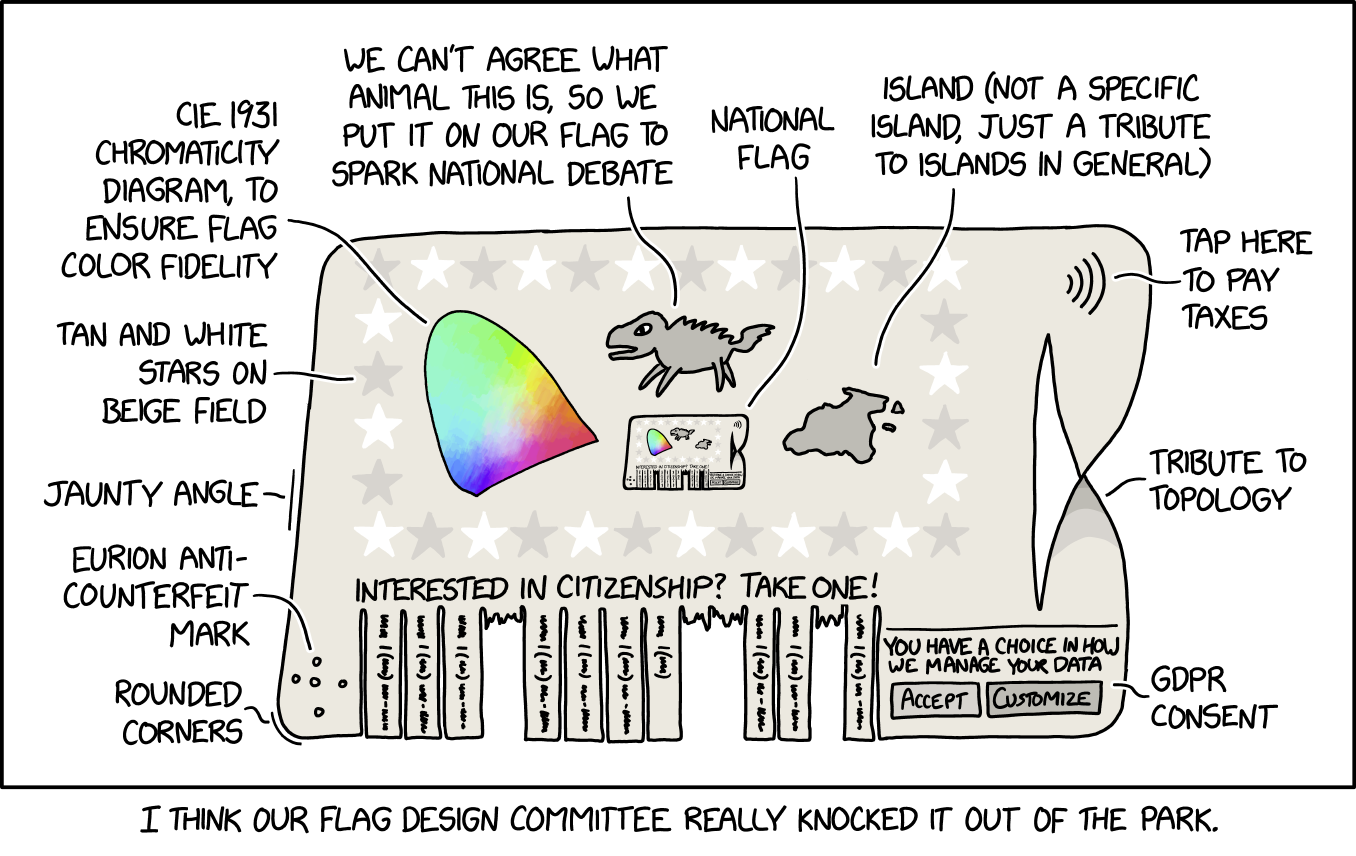
xkcd of the day, 5/25 - Flag Design #3250